Why take this course
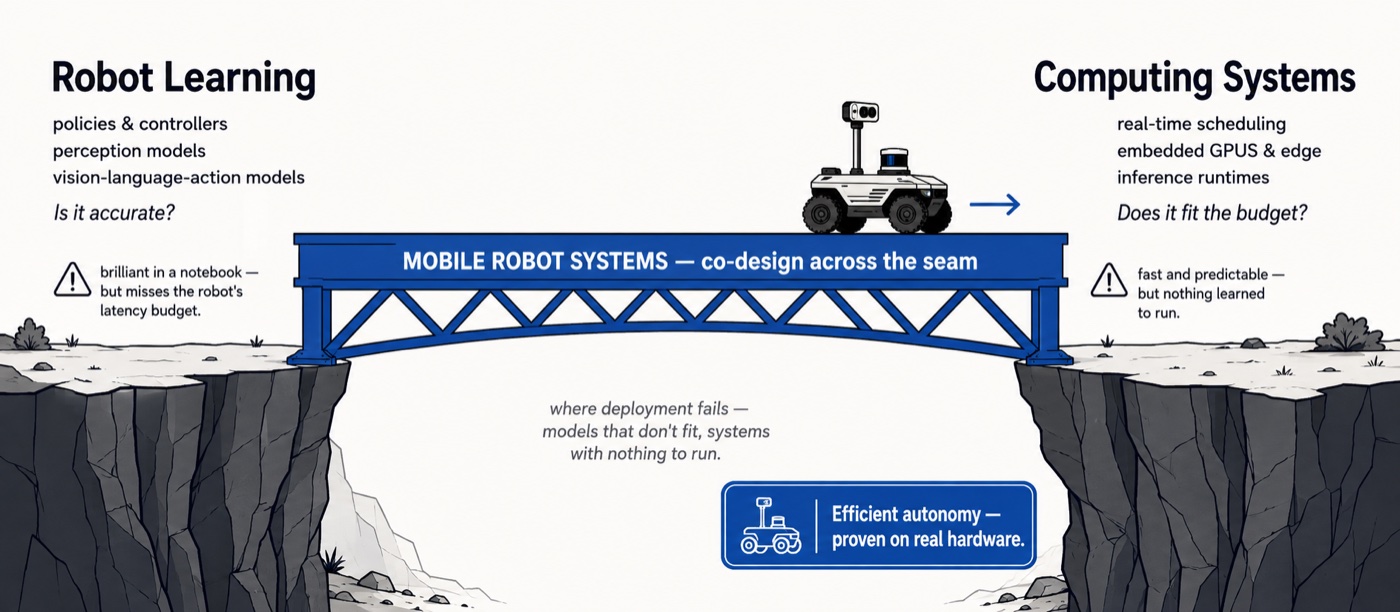
A policy that is brilliant in a notebook is useless on a robot if it can't meet the latency budget — and dangerous if it fails silently. This course lives on the seam where deployed autonomy actually succeeds or fails.
End on a real robot
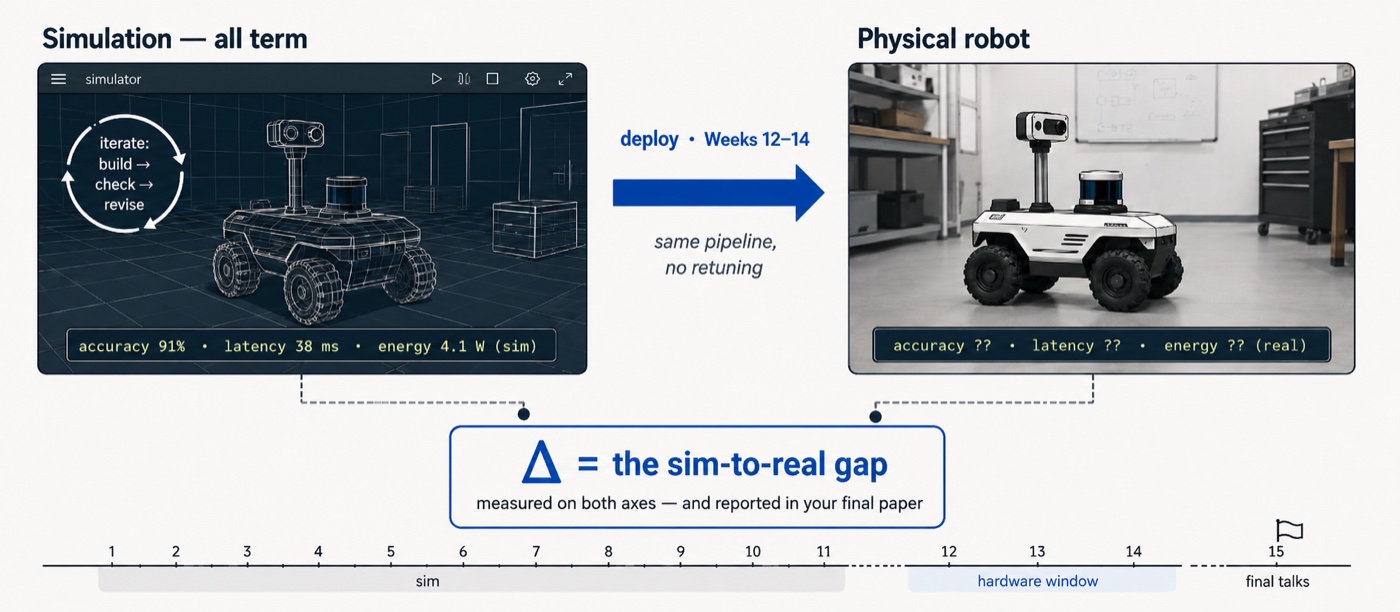
Every project develops sim-first, then deploys to Jetson-powered ground robots or Crazyflie micro-drones and measures the sim-to-real gap. "Does it actually work?" becomes a number.
ML or systems — not both
The course levels each side up on the other: the modular autonomy pipeline (sensing, perception, planning, control) for systems folks; real-time, edge, and inference systems for ML folks.
Build, measure, publish
No final exam. The capstone is a semester project — make an autonomy capability efficient, then defend it with measurements in a workshop-style paper and talk.
At a glance
Grading
Team model: the course project is required of CS 5331 students only, individually or in a team of up to 3; CS 4331 students do not complete a project — the one difference between the sections. Percentages above are the CS 5331 ledger; without the project the CS 4331 ledger renormalizes to Labs 46.2%, presentation 15.4%, critiques 15.4%, midterm 15.4%, in-class 7.7%.
What you'll build
Eight project directions — every one touches both sides of the bridge and ends with a hardware reality-check. Or propose your own.
Anytime perception on a budget
An early-exit / cascaded detector; map the accuracy–latency–energy frontier.
Visuomotor policy on a deadline
A sim-trained driving policy quantized and accelerated until it hits the control deadline on-device; task success vs. latency, sim vs. real.
Adaptive edge offloading
Split perception between robot and edge under replayed network traces; the split adapts as the link degrades.
LiDAR localization on a memory budget
2-D SLAM with a bounded-memory map; the accuracy vs. memory/latency frontier; real drift vs. sim.
Compress a big model for the edge
Distill / quantize a large vision model onto the Orin Nano within a frame-time budget; measure the accuracy cost.
Sim-to-real warmup study
How a short, cheap on-robot adaptation phase closes the sim-to-real gap — the reality-check is the core of the project.
Collaborative perception
Two robots — or a drone swarm — share detections over WiFi; accuracy gain vs. bandwidth and latency cost.
Autonomy-stack measurement study
Profile a ROS 2 pipeline on the Orin Nano under load; locate the efficiency bottlenecks.
Schedule
28 sessions, five arcs, every one dated (Tue/Thu 8:00–9:20 AM). Most sessions from Week 3 on end with a 20-minute student paper slot.
Arc 0 — Framing Week 1
| Session | Date | Topic | Paper / milestones |
|---|---|---|---|
| L1 | Tue Aug 25 | Bridging robot learning and computing systems. The two communities; what efficient end-to-end autonomy demands. | Presentation sign-up opens |
| L2 | Thu Aug 27 | A tour of real end-to-end autonomous systems. AV stacks, drones, manipulators — where efficiency breaks. | Instructor models the paper slot |
Arc 1 — Pillar I: How autonomy is built & learned Weeks 2–5
| Session | Date | Topic | Paper / milestones |
|---|---|---|---|
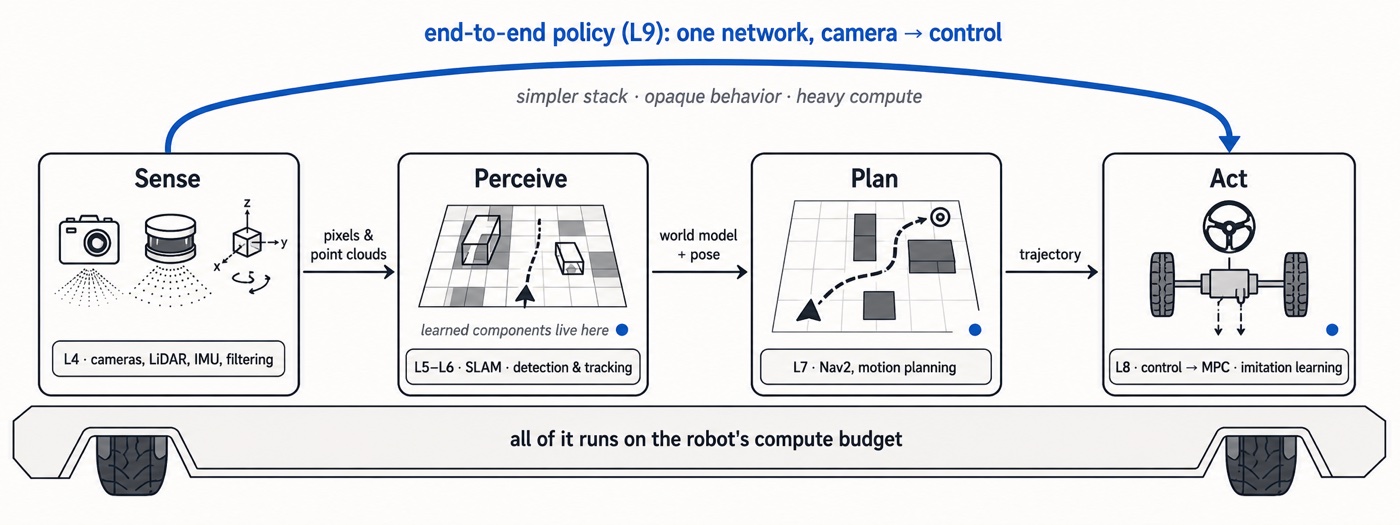
| L3 | Tue Sep 1 | The modular autonomy pipeline. Sense → perceive → plan → act; where learning enters. | |
| L4 | Thu Sep 3 | Sensing and state estimation. Cameras, LiDAR, IMU; KF/EKF; learned estimation. | Lab 1 out |
| L5 | Tue Sep 8 | Perception I — localization & mapping. SLAM fundamentals. | |
| L6 | Thu Sep 10 | Perception II — detection, segmentation, tracking. | YOLO · first student slot |
| L7 | Tue Sep 15 | Planning and navigation. Motion planning; Nav2; learned planning. | Nav2 · group + topic due |
| L8 | Thu Sep 17 | Control, and learning for control. PID → MPC; imitation learning; RL in brief. | Diffusion Policy |
| L9 | Tue Sep 22 | End-to-end & foundation models vs. the modular stack. VLAs — what E2E buys and costs. | RT-2 · Lab 1 due |
Arc 2 — Pillar II: How robots compute Weeks 5–8
| Session | Date | Topic | Paper / milestones |
|---|---|---|---|
| L10 | Thu Sep 24 | Robot software systems. ROS 2, the compute graph, execution. | ROS 2 |
| L11 | Tue Sep 29 | Real-time systems for robots. Deadlines, WCET, scheduling. | ROS 2 response-time · Lab 2 out |
| L12 | Thu Oct 1 | The robot compute platform. CPU/GPU/NPU; power budgets; profiling the course Jetson. | Proposal due |
| L13 | Tue Oct 6 | ML and inference systems. How DNNs execute; runtimes and accelerators. | TVM |
| L14 | Thu Oct 8 | Edge, cloud, and connected robots. Offloading trade-space; V2X connectivity. | Neurosurgeon |
| L15 | Tue Oct 13 | Midterm exam — in class, open-book, covering both pillars. | Lab 2 due |
Arc 3 — The Bridge: Efficiency Weeks 8–13
| Session | Date | Topic | Paper / milestones |
|---|---|---|---|
| L16 | Thu Oct 15 | The efficiency gap. A learned policy vs. the robot's budget; how to measure. | |
| L17 | Tue Oct 20 | Making models fit. Quantization, pruning, distillation. | Integer-only quantization · baseline due |
| L18 | Thu Oct 22 | Anytime and input-adaptive inference. Cascades, early exit; the accuracy–latency–energy frontier. | BranchyNet · Lab 3 out |
| L19 | Tue Oct 27 | System-level efficiency I — scheduling. Learned workloads under deadlines. | D3 |
| L20 | Thu Oct 29 | Project milestone presentations. | Milestone |
| L21 | Tue Nov 3 | Hardware-aware model design & NAS. Efficient architectures; once-for-all networks. | Once-for-All |
| L22 | Thu Nov 5 | Energy and power management. Measuring energy on the Jetson; DVFS; energy-aware inference. | Energy-aware inference paper |
| L23 | Tue Nov 10 | System-level efficiency II — offloading & split computing. Robot↔edge splits on replayed traces; co-design. | Split-computing paper |
| L24 | Thu Nov 12 | Data systems for robot learning. Datasets, auto-labeling, the fleet data flywheel. | RT-X · Lab 3 due · reality-check opens |
| L25 | Tue Nov 17 | Efficient training & on-robot adaptation. Training vs. inference cost; PEFT; continual adaptation. | Efficient-training paper |
Arc 4 — The end-to-end system Weeks 13–15 + finals
| Session | Date | Topic | Paper / milestones |
|---|---|---|---|
| L26 | Thu Nov 19 | Integrating the system. Cross-layer co-design; sim to physical robot. | |
| L27 | Tue Nov 24 | Connected and collaborative autonomy. V2X, cooperative perception, swarms, connected-vehicle stacks. | V2VNet |
| L28 | Tue Dec 1 | Final project presentations I. | Part II in the final-exam block (Dec 4–9) · report due Dec 9 |
Three labs, one ladder
Each lab builds a skill on one side of the bridge — the last crosses it on real hardware.
Stand up the pipeline in simulation
Bring up a TurtleBot 4 or a Clearpath Husky in Gazebo, map its world with SLAM, and navigate the map with Nav2 — sense → perceive → plan → act. Out Sep 3 · due Sep 22.
Profile it as a system
Instrument that navigation stack — a ROS 2 graph — and measure end-to-end latency and where time actually goes. Out Sep 29 · due Oct 13.
Cross the bridge on real hardware
Deploy to a Jetson robot: compress and accelerate until it hits an on-device latency budget — measure accuracy, latency, and energy on the device. Out Oct 22 · due Nov 12.
The fleet
🚗 Jetson ground robots ×4
JetBot-class differential drive: NVIDIA Orin Nano + camera + 2-D LiDAR. The on-device efficiency platform — compression, anytime inference, and localization projects run here.
🚁 Crazyflie drones ×3
27-gram open-source micro-quadcopters — too small to compute onboard, so they embody the offloading problem, have a sharper sim-to-real gap, and are swarm-native.
Development is sim-first (Gazebo / Isaac Sim, public datasets, cloud GPUs); the fleet is booked late-term for every project's hardware reality-check.
Register & logistics
How to register
Register on Raiderlink for Fall 2026: CS 4331 (senior undergraduates) or CS 5331 (graduate students) — dual-listed, meeting together Tue/Thu 8:00–9:20 AM in Holden Hall 00075. Questions about fit or background? Email liangkai.liu@ttu.edu — or drop by office hours, Tue 2–3 PM & by appointment.
What you need coming in
Python and C++, linear algebra and probability, and a background in either ML or systems — the course levels you up on the other side. No robotics experience assumed. CS 4331 expects CS 2413 plus one of CS 3375 / CS 4352 / an intro AI-ML course.